
Jump to a section View topics
The answer depends on what happened to the car
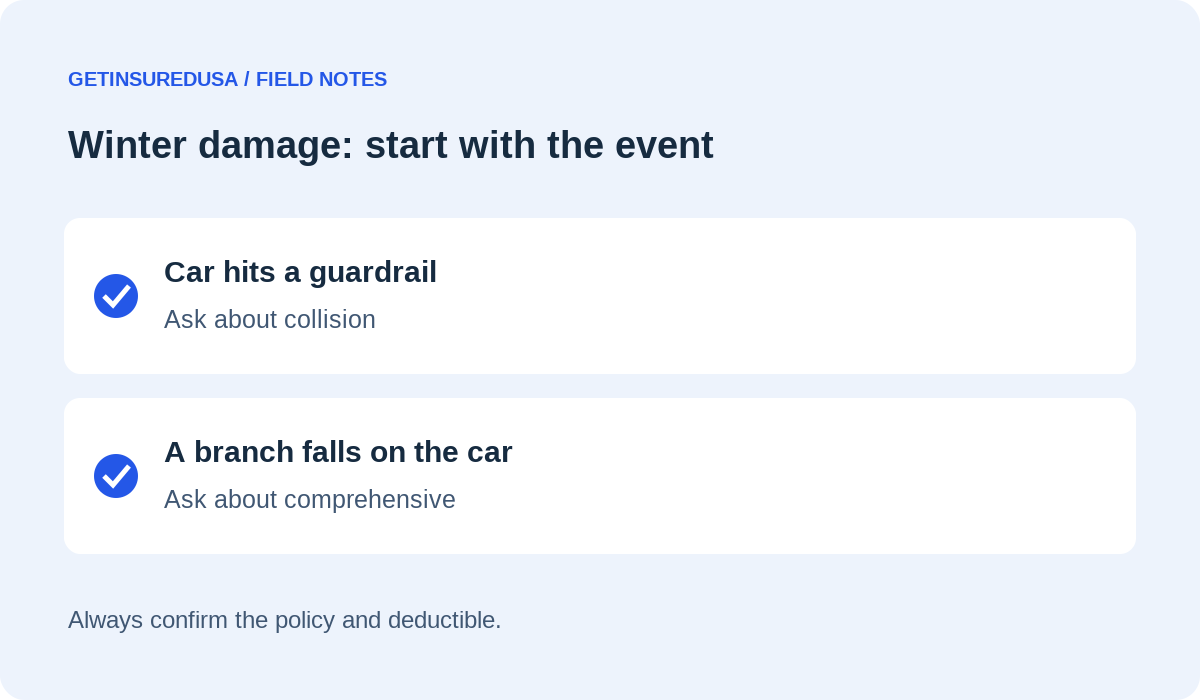
Snow on the forecast does not tell you which part of your auto policy would respond to damage. A branch landing on a parked car and a car sliding into a guardrail are different losses. Comprehensive is generally the coverage to ask about for falling objects and certain weather damage. Collision is generally the coverage to ask about when your car hits another vehicle or object. Your actual policy, deductible and circumstances decide the claim.
That distinction is worth checking before the first storm, particularly if you recently changed insurers or increased a deductible to lower the premium. Open the declarations page and find the separate comprehensive and collision entries. Liability coverage protects against certain losses you cause to others; it does not automatically pay to repair your own car. “Full coverage” on an advertisement is not a reliable inventory of your protection.
This guide walks through winter situations U.S. drivers can discuss with an insurer, without promising that any one policy covers every example. You will also find a practical way to compare a repair estimate with your deductible, questions about transportation while the car is repaired, and a phone-friendly preparation checklist. GetInsuredUSA is an information and referral publisher. Insurers and their authorized representatives make coverage and claim decisions.
Start with a five-minute policy check
Find the vehicle identification number on the policy and make sure you are reading the entries for the correct car. Households sometimes carry comprehensive and collision on one vehicle but not another. A coverage change made when an older car was paid off can be easy to forget until damage occurs. Save the current declarations and the insurer's claims contact in a place you can access without your home computer.
Next, record both deductibles. Do not assume the comprehensive amount matches collision. Ask whether glass has its own terms, whether rental reimbursement is selected, and whether roadside assistance is included or purchased separately. Those items answer different problems. A policy that can reimburse a covered repair may still leave you arranging a tow or paying for a temporary car under different limits.
If a lender or leasing company has an interest in the vehicle, review its insurance requirements before changing anything. Lowering the monthly bill by removing coverage may create a separate problem under the financing agreement. Our comprehensive coverage guide explains the basic distinction; use it to prepare questions, then have the provider identify the applicable wording in your own policy.
Sliding on ice: why collision matters
Picture a low-speed turn that ends with your car against a concrete barrier. The road surface explains how the accident happened, but that does not make the damage a comprehensive claim simply because the weather was involved. Ask the insurer about collision coverage for damage to your vehicle. If other people or property were involved, separate liability questions may also need attention.
Avoid assuming that being careful, driving slowly or encountering unexpected black ice guarantees a particular fault decision. Give an accurate account of the event and let the insurer review the facts. Preserve photographs when it is safe to take them, including the vehicle, location and damage. Do not put yourself in traffic to collect evidence or attempt repairs beside a dangerous road.
When comparing policies before winter, ask for collision quotes using the same limits and only one deductible change at a time. That makes the premium difference understandable. Our collision guide and deductible comparison can help you organize the trade-off between a lower premium and the cash you would need after a covered accident.
Falling ice, branches and damage while parked
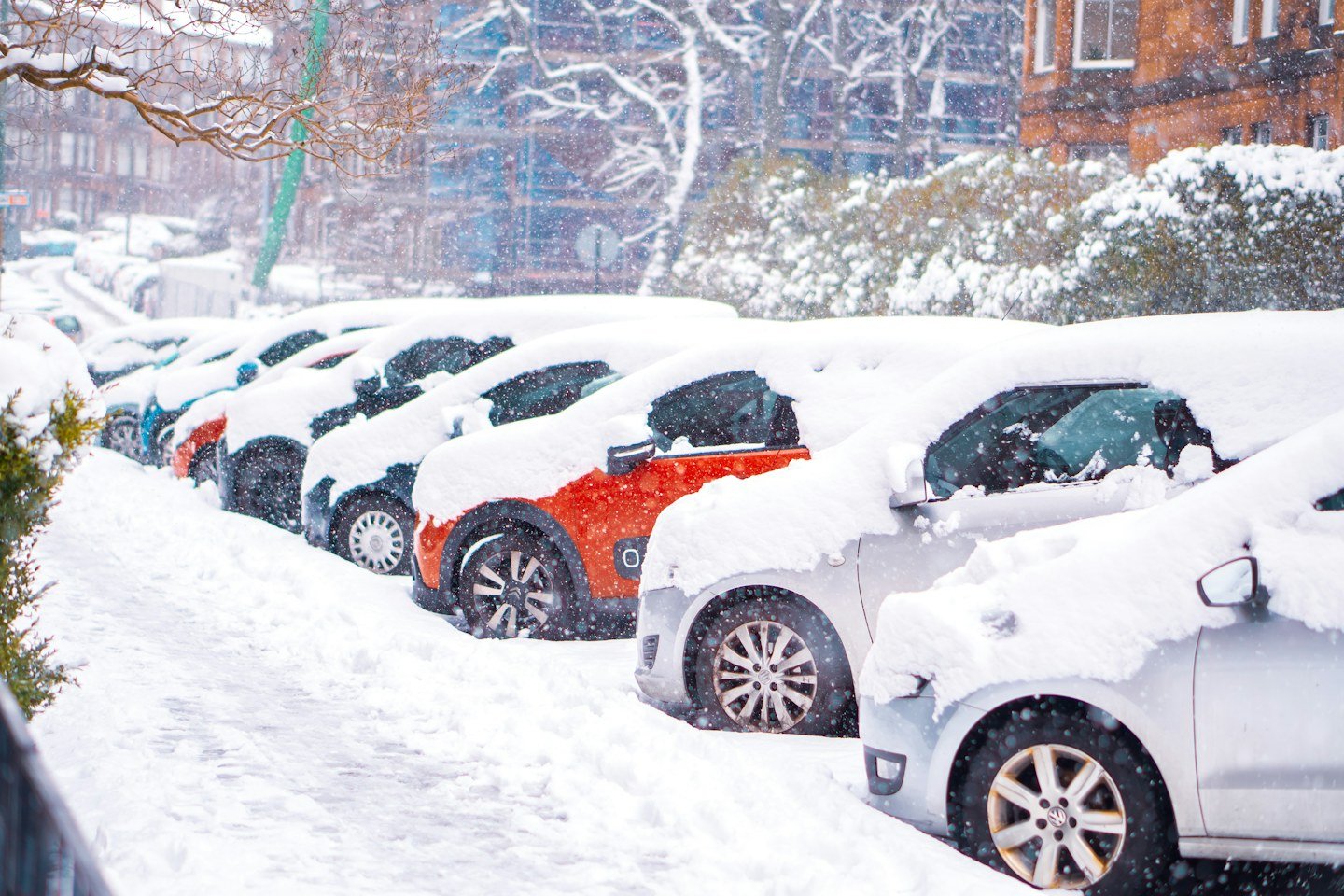
A car does not need to be moving to suffer an expensive winter loss. Ice can fall from a roof, a heavy branch can break, or storm debris can strike a parked vehicle. Comprehensive is generally the starting point for discussing falling-object damage. An adjuster still needs the actual cause, damage information and policy terms; the season itself does not establish coverage.
After discovering damage, take reasonable steps to prevent further loss when it is safe, and ask the insurer how to proceed before authorizing substantial repairs. Keep receipts for necessary protective work and document what was done. If a damaged windshield or roof makes the vehicle unsafe, arrange suitable transport rather than driving it just to obtain an estimate. Ask about the insurer's preferred inspection process.
Do not assume the owner of a nearby tree or building automatically pays. Responsibility can depend on facts beyond the location of the damage. Your immediate task is to report accurately and identify the coverage available under your policy. Questions about another party's liability may require a separate review; a neighbor's reassurance is not a substitute for instructions from the claims team.
A cracked windshield needs its own question
Glass damage can be awkward because a repairable chip and a windshield replacement may have different costs and policy treatment. Ask whether repair and replacement use different deductibles or benefits. Do not assume a national advertisement about glass applies to your state, endorsement and exact loss. Save the written answer with the quote if this feature affects your choice of insurer.
For a vehicle with cameras or driver-assistance technology near the windshield, ask the repairer whether calibration is required and whether the estimate includes it. Have the insurer explain how those charges are handled. The right question is about completing a safe repair to the vehicle's requirements, not simply finding the smallest glass-only price on an online booking screen.
Our windshield repair and replacement guide covers the questions to bring to a provider. If a crack appears during cold weather, describe when you first noticed it and any known impact. Do not guess at a cause or present an old chip as new storm damage. An honest timeline helps the insurer assess the claim.
Salt, corrosion and ordinary maintenance
Winter also exposes problems that are not the same as sudden accidental damage. Rust, worn tires, an aging battery or a cooling-system problem may call for maintenance or a separate warranty discussion. Comprehensive coverage is not a general promise to fix everything that goes wrong during a cold month. Ask the provider to distinguish a covered event from wear, deterioration and mechanical issues.
That distinction is especially useful when you buy a used vehicle late in the year. A fresh policy does not erase existing damage. Keep the inspection report, photographs and any seller disclosures, and ask how pre-existing damage affects a future claim. If the seller mentions an extended warranty or service contract, read it separately from the auto insurance policy rather than treating the products as interchangeable.
Set aside a maintenance budget as well as an insurance deductible reserve. A low premium does not make an unreliable car inexpensive to own. Before a long winter trip, follow the vehicle manufacturer's maintenance guidance and seek qualified advice about safety concerns. Insurance shopping and vehicle preparation support different parts of the same household budget; neither replaces the other.
Flooded roads and water damage
Rain, snowmelt and blocked drainage can leave water where you normally drive or park. Comprehensive is commonly the coverage to ask about for flood damage to an insured vehicle, subject to the policy. Do not interpret that as permission to enter standing water. A coverage discussion belongs after the immediate safety decision, and the safest route may be to avoid the road entirely.
If a car has been exposed to floodwater, explain the circumstances to the insurer and ask about inspection and transport before trying to restart it. Follow qualified safety guidance, especially around damaged electrical components. For an electric vehicle, tell the responder or repair facility the exact model and any known water exposure. A familiar-looking car can require a different handling procedure after damage.
When checking your policy in advance, ask how towing, storage and inspection costs are handled. Those charges can become a source of confusion while everyone is focused on the repair estimate. Record who authorized the tow, where the car is going and how to contact the facility. A small written record is easier to reconstruct than a chain of hurried phone conversations.
Deer and other animal collisions
Animal-related damage is another reason to read coverage categories carefully. Direct contact with an animal is generally a comprehensive question. Swerving to avoid an animal and striking a guardrail can instead raise a collision question. Those examples show why the details of what the vehicle actually hit matter more than a broad description such as “winter road accident.”
Report the event as it happened, including whether there was contact with the animal and whether another vehicle or object was involved. Do not change the account because one deductible is lower. The insurer needs accurate facts to evaluate the policy. If you are comparing coverage before a trip, ask the representative to explain these two scenarios and point out any relevant exclusions.
Wildlife damage, rodent damage and a roadside breakdown are not automatically the same coverage question. If you store a vehicle for part of the season, ask specifically about the kinds of damage that concern you. A short written list of scenarios is more useful than asking whether “everything involving animals” is covered. The answer may differ by damage cause and policy wording.
Work through the deductible before deciding
Suppose a hypothetical covered falling-branch repair is estimated at $1,650 and the applicable comprehensive deductible is $1,000. Simple subtraction suggests $650 remains after the deductible, before considering policy terms, valuation and the insurer's approved amount. This is a budgeting example, not a claim offer. An actual settlement can involve details that a repair estimate alone does not resolve.
Now imagine the deductible is $500 instead. The same arithmetic produces $1,150 after the deductible, but you would need the premium difference to compare those choices before buying coverage. Ask for the cost of each deductible on an otherwise identical quote. Then decide whether paying the extra premium fits your budget and whether you could comfortably fund the higher deductible after a loss.
Also consider separate incidents. A storm loss in December and a later collision are not necessarily one shared deductible expense for the year. Ask how your policy handles each event. Keep your emergency reserve separate from money already committed to rent, groceries or loan payments. A deductible is a practical cash requirement, not just a number that makes a quote look cheaper.
Rental reimbursement and roadside help
Damage coverage and temporary transportation are separate entries to review. If your car needs a covered repair, ask whether rental reimbursement is selected, what daily and overall limits apply, and when the benefit starts and ends. Do not assume it pays for every day you would prefer to keep a rental car. A repair delay or vehicle valuation decision may require a specific conversation.
Roadside assistance raises different questions: the services included, towing distance or dollar limits, dispatch arrangements, exclusions and any overlap with an automobile club or manufacturer program. A battery jump on a cold morning is not the same transaction as transporting a damaged car after a claim. Check which number to call for each situation and save both if they differ.
For a household with one car, think about the first day after a loss, not only the final repair bill. Could you work remotely, borrow a vehicle with permission and appropriate coverage, or pay for transportation temporarily? Ask the insurer before assuming another vehicle is insured for your use. Planning that first day often reveals a more important gap than a small premium difference.
A mobile-friendly claim record
Create a note with the date, time, location, policy number and a short factual description. Add the claim number and representative's contact details when you receive them. Keep photos in the same folder or album. Avoid editing the originals in a way that obscures important details; save annotations separately if you need to explain what a photograph shows.
Track estimates, receipts, towing records and promised next steps. A useful note says, “Inspection expected Tuesday; call this number if no appointment arrives,” rather than “They are handling it.” Ask what you may authorize and what needs prior review. If another person in your household is helping, use a shared record so two people do not accidentally approve conflicting arrangements.
Keep sensitive information out of public social-media posts. An insurer's secure upload channel is a better place for policy documents than an unfamiliar email address supplied in a comment. Verify unexpected claim-related calls through the number on your policy. GetInsuredUSA does not process claims, inspect damage or request your payment details to release an insurance benefit.
Compare winter protection without buying duplicate benefits
Start with the coverage you already have, then identify the unanswered problem. Perhaps it is paying a comprehensive deductible, arranging a tow, or managing several days without a car. Ask providers to price solutions to that specific problem. Buying multiple products with similar names can create expense without resolving the gap you actually care about.
Keep the policy period consistent when comparing prices. A six-month quote and a twelve-month quote need their terms labeled clearly; a first installment is not the total premium. Record payment fees, coverage selections and effective dates alongside the price. The quote comparison worksheet gives you a place to hold these details without collecting consumer information on this website.
Do not cancel an existing policy while a replacement is only a saved quote. Confirm the insurer, accepted payment, effective date and proof of coverage first. Ask the old provider about its cancellation process and any refund or fees. The objective is a deliberate transition, with enough documentation to show which coverage was in force at the relevant time.
A worked household winter review
Consider a fictional household with two cars: a financed SUV used daily and an older paid-off sedan used occasionally. Their first assumption is that both have identical protection because they share a policy number. The declarations show otherwise. The SUV has comprehensive and collision; the sedan has liability selections only. Their winter review starts by correcting that misunderstanding, rather than shopping for a discount immediately.
They ask for an itemized quote to add comprehensive to the sedan, explain how it is parked and used, and request two deductible options. They also ask whether collision is available separately and how existing damage would be treated. No one assumes that comprehensive would pay if the sedan slid into a pole. The questions follow the actual risks the household is deciding whether to fund itself.
For the SUV, the family checks the lender's requirements and learns the price of adding rental reimbursement. They compare the quoted benefit limits with their likely transportation needs. They check their separate roadside membership before paying for an overlapping feature. Each choice is recorded with its price and conditions, so the eventual decision is based on concrete differences rather than the phrase “winter protection package.”
This example has no universally correct shopping result. The family may retain some risks and insure others. Its useful feature is the method: identify the car, describe the event, locate the coverage, check the deductible and price the missing benefit. You can follow those steps even if your household, state, vehicles and available insurers are completely different.
If the first repair estimate changes
An initial estimate may not answer every repair question. Ask the shop and insurer what happens if additional damage is found after work begins. Record who submits the supplemental estimate and whether authorization is required before proceeding. Do not assume a conversation about possible extra work is the same as approval of a final amount. Clear communication matters particularly when a car has hidden structural or electronic damage.
Ask how payment is made and to whom. A check involving a lender, a payment sent to a repairer and reimbursement to you can require different steps. Confirm your own deductible responsibility before collecting the vehicle. Keep the itemized invoice and inspection documents. If you disagree with an amount or repair decision, ask for the insurer's explanation and review process rather than relying on an informal promise from someone outside the claim.
For a repair delay, track transportation expenses separately from the repair bill. Ask about rental limits before assuming another week will be reimbursed. If the benefit is approaching its limit, discuss realistic options promptly. A list of dates, receipts and contacts makes that discussion easier, especially if several people have worked on the file. The aim is a documented answer while you can still adjust your plans.
When your winter address changes
If you spend part of the year in another state, explain the arrangement to the insurer. Give accurate information about where the car is principally kept and how long it stays there. Ask whether the policy, registration or driver information needs attention. Do not decide which address to use based only on the cheaper preliminary quote. Different agencies and contracts can have different requirements for your situation.
Carry current proof and save the insurer's contact details before traveling. Ask how a claim away from home would be handled and where you could obtain qualified repair help. A plan that works for a local commute may need additional preparation for months elsewhere. If you leave another vehicle behind, discuss its actual use and parking arrangement separately rather than assuming both cars face the same exposure.
Check any planned coverage change before departure, and save its confirmed effective date. Keep protection for relevant parked-car losses in mind when discussing lower use. A car sitting in a driveway can still face storm damage or theft. Review our state resources for official contacts, then ask the licensed provider to explain how the policy fits the facts you have described.
Questions drivers ask before the first storm
Does liability insurance pay for snow damage to my car?
Liability does not generally repair your own vehicle. Ask about comprehensive for relevant non-collision losses and collision for damage from hitting another vehicle or object. Check the exact event and selected coverages with the insurer; a liability limit on a declarations page is not evidence that either vehicle-damage coverage was purchased.
Can I add comprehensive after the storm?
You can ask about future coverage, but adding it does not turn earlier damage into a covered future event. Describe any existing damage accurately. Confirm the effective date and any inspection requirements before relying on a change. Do not assume submitting a request means the insurer has accepted it or that coverage starts immediately.
Should I raise my deductible for winter?
Compare the actual premium savings with the additional out-of-pocket amount you would accept. There is no single deductible that suits every driver. Consider access to cash, vehicle value, lender requirements and the possibility of separate losses. Ask for otherwise identical quote versions so unrelated coverage changes do not distort the comparison.
Is winter tire damage covered?
Ask about the cause and the policy. Worn tires, road hazards, a collision and damage during a covered event are different situations. An auto policy, tire warranty and roadside program may answer different questions. Give a factual description rather than assuming the time of year determines coverage, and have the provider explain any applicable exclusion.
Sources and a practical next step
Research checked November 26, 2026: Progressive's snow-damage explanation, Liberty Mutual's winter weather guide, Oregon's winter consumer newsletter, and the NAIC auto insurance consumer resource. Carrier examples describe published explanations, not endorsements or a promise that an advertiser campaign is available in your state.
Before your next drive, save your policy contacts, review the two vehicle-damage deductibles and write down one unresolved coverage question. That is a manageable first step on a phone. If you decide to compare offers, carry the same selections into each quote. A licensed provider can explain the contract; our state guides can help you find official local resources.