

Jump to a section View topics
Low mileage is a reason to compare, not a savings guarantee
If your car spends more time parked than moving, pay-per-mile car insurance may be worth comparing with a conventional policy. The important question is the complete price for your actual driving, including the base charge, mileage charge, selected protection and any fees. A low per-mile figure alone does not tell you whether the policy will cost less than the coverage you already have.
Also distinguish mileage-based pricing from a driving-score program. Some arrangements focus on distance, while others use information about how or when you drive. A low-mileage discount on a conventional policy is another possibility. These products can look similar in an advertisement while measuring different things. Ask the provider which arrangement it offers and how the bill can change.
This guide is for U.S. drivers who work remotely, use transit, share a household vehicle, retire from a daily commute or simply drive less than before. It does not name a universally cheapest provider or promise an available program in every state. GetInsuredUSA provides education and advertising referrals. The insurer determines eligibility, coverage and price under the product actually offered to you.
Three arrangements that deserve separate comparisons
A pay-per-mile policy may combine a recurring base amount with a charge based on miles driven. Ask how the mileage is measured, when it is billed and whether a quoted per-mile amount is fixed for the term. Do not assume the plan eliminates every other rating factor. Have the provider explain the quote using your vehicle, drivers and address.
A telematics or usage-based insurance program may collect driving information to help determine pricing. Depending on the program, relevant measures can include mileage, timing and driving behavior. Ask which factors matter, whether your initial price is temporary and whether the eventual result can increase the premium. An enrollment benefit and an ongoing driving-based adjustment are not necessarily the same thing.
A conventional low-mileage discount can be simpler for some drivers, but it still has eligibility and verification rules. Ask how much driving qualifies, how estimates are checked and what happens if your use changes. Compare its final price with the other arrangements using the same limits and deductibles. A discount's percentage is less useful than the resulting policy-period cost.
Estimate mileage from your life, not your best month
Use recent odometer readings or reliable records to estimate driving. Include commuting, shopping, medical visits, school activities, weekend trips and visits to family. A quiet work-from-home week may not represent the rest of the year. If your schedule is changing, build a range rather than pretending you know an exact number that the coming months may not support.
Separate predictable miles from occasional trips. For example, record your normal local driving, then add an estimate for a planned vacation or recurring long-distance visit. Ask the provider how higher-mileage days and billing periods are treated. Some products may have specific daily limits or rules; do not assume those features exist without checking the actual policy or program documents.
Keep the estimate honest. Understating the commute to obtain a lower quote can leave you with a price that does not reflect the real use of the car. If delivery work, rideshare activity or business travel is involved, disclose it directly and ask about appropriate protection. Mileage-based billing does not by itself establish that every type of driving is covered.
Calculate a break-even point with hypothetical numbers
Suppose a fictional mileage-based quote has a $55 monthly base amount and a charge of 7 cents per mile. At 400 miles, the simple calculation is $55 plus $28, or $83 for that month before any additional charges. At 1,000 miles, it becomes $125. These are invented figures for explaining arithmetic, not an available offer or an estimate of your insurance price.
If an otherwise comparable conventional quote were $110 for the same hypothetical monthly period, the difference above the base amount would be $55. Dividing $55 by $0.07 gives roughly 786 miles. Under these simplified assumptions, that is the point at which the mileage calculation reaches $110. Fees, different coverage, billing rules or changed rates would alter the result.
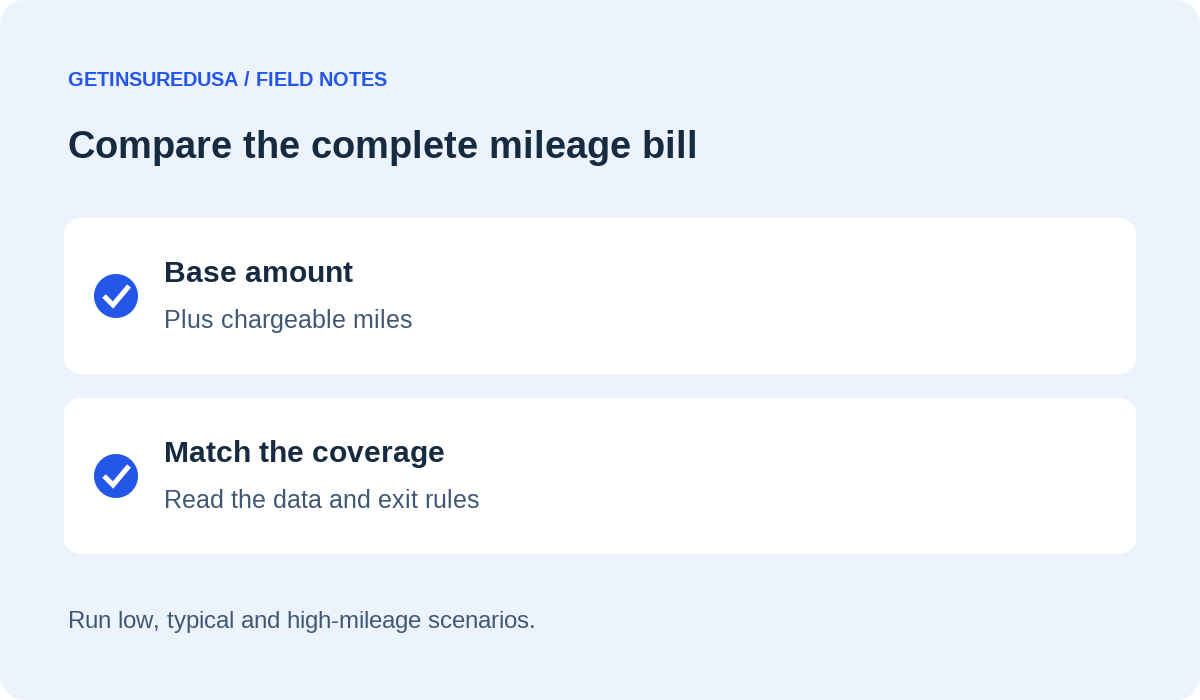
Ask the provider to run its own calculation for three mileage levels you could realistically reach. Label each with the full coverage selections and quote date. Our car insurance comparison worksheet can hold the results. The goal is to understand a range of bills, not use a neat break-even number as a promise about the coming year.
A low base amount can hide a different policy
Before comparing totals, match the protection. Check liability limits, comprehensive and collision selections, both deductibles, injury benefits, uninsured-driver options and any endorsements. A low-mileage product with reduced coverage is not a like-for-like alternative to a broader conventional policy. Ask for a revised quote if you cannot tell which difference accounts for the lower price.
If the vehicle is financed or leased, confirm the contract's insurance requirements. A product can be attractive on price yet unsuitable if it does not meet those requirements. Have the insurer explain how the lender is listed and what proof it receives. Do not remove protection from the existing policy while you are only exploring a mileage-based estimate.
Review optional benefits separately. Rental reimbursement and roadside assistance may matter just as much to someone who drives rarely, particularly in a one-car household. A vehicle that is used only twice a week can still be essential on those days. Ask about benefit limits and exclusions rather than assuming low mileage makes temporary transportation an unimportant issue.
What the app or device actually measures
Ask whether the program uses a phone app, a vehicle device, connected-car data, odometer photographs or another method. Then ask what information is collected beyond distance. A product's name may emphasize miles even when additional information is involved in operating the program. Read the privacy notice and the enrollment terms before enabling permissions or connecting the vehicle.
For app-based programs, discuss practical situations: riding as a passenger, taking public transportation, using a second vehicle and sharing a phone. Ask how incorrect trips are identified and corrected, and how much time you have to make a correction. A feature that works well for one household may be inconvenient if the same driver regularly moves between several vehicles.
For a plug-in or vehicle-based system, ask about installation, compatibility, missing readings and device return procedures. If the car is in a repair shop or the device stops working, find out how to report the problem. Save the instructions. Do not assume removing the device or disabling an app is an approved way to pause charges or leave the program.
Privacy needs more than a permission pop-up
Read what the insurer and any service provider say about collecting, using, retaining and sharing data. Ask who can receive it, how long it is kept and whether it is used only for this insurance program. A phone's permission screen tells you something about technical access; it does not summarize every business use described in the program's terms.
The Maryland Insurance Administration warns that connected vehicles and related apps can collect driving information and may share it with others, including insurers. That is a separate issue from knowingly joining your insurer's own program. Review vehicle-manufacturer settings as well as insurance-app settings. Do not assume declining one program resolves every possible source of driving data about the car.
When a question matters to you, ask it in writing. For example: “Can you explain which driving data affects my premium and which information is shared outside the program?” Save the response with the enrollment documents. If you are uncomfortable with the arrangement, compare a conventional quote rather than agreeing to permissions simply because the introductory price is appealing.
Can telematics raise the insurance price?
Ask the provider whether the product is discount-only or can result in a higher price, and at what stage. Enrollment, completion of a monitoring period and renewal may be separate points. A statement about an initial discount does not necessarily explain the final adjustment. Have the representative describe a less favorable outcome as clearly as a favorable one.
Also ask how ordinary rate changes interact with the program. Even if a driving score improves, other elements of a renewal price may change. A lower score-related adjustment does not automatically mean the total renewal premium will fall. Request an explanation that separates the program result from other changes when you compare one term with the next.
Avoid treating another person's percentage savings as an expected result for your household. They may live in a different state, use different coverage and drive a different vehicle. Published maximum discounts are not personal quotes. Record the actual amount offered to you, the conditions for keeping it and the outcome if you stop participating or fail to provide required information.
Remote workers: price the occasional commute too
A remote schedule can reduce mileage without eliminating driving altogether. Include office visits, errands and trips you previously combined with commuting. If you now make several separate local trips, your total may differ from an estimate based only on the commute you no longer make. Use actual odometer changes where possible instead of calculating savings from job status alone.
Ask how a return-to-office change should be reported. You may need to revisit both the mileage estimate and the vehicle-use description. Keep the reporting process simple enough that you will actually follow it. A policy that fits a quiet month should not become confusing when work requires extra travel or a new routine begins midway through the term.
Compare the mileage plan with asking your current insurer to update your driving information. The useful alternative may already be available without moving companies or joining a new tracking program. Our discount guide helps you build a question list, but the insurer must confirm which adjustments apply to your policy and how they affect the final price.
Retired drivers and a second household car
Retirement can change driving patterns in both directions. The daily commute may disappear, while daytime errands, visits and extended travel increase. Build the estimate around the new routine rather than assuming fewer work trips always mean very low annual mileage. Ask providers to price a realistic range so a longer trip does not make the bill surprising.
For a second vehicle, estimate its own use rather than dividing household mileage evenly. Check who drives it and where it is kept. Discuss any shared-driver arrangements with the insurer, and ask whether moving one car affects discounts or terms on the remaining policy. A cheaper standalone quote may change the household's total insurance cost elsewhere.
If the car will be stored for part of the year, ask about legitimate storage arrangements and the effect on registration, financing and coverage. Mileage-based insurance is not automatically a storage policy. A parked car can still face theft, weather and other losses. Our winter coverage guide explains why miles driven and exposure to parked-car damage are separate questions.
Road trips and unusually busy months
Check the product's treatment of road trips before choosing it based on an ordinary month. Ask whether a daily mileage cap exists, how it works, whether all driving is still recorded and which charges remain. A cap mentioned on a marketing page may have state or product limitations. Save the document that applies to the offer you are considering.
Work through a hypothetical vacation month using the provider's actual calculation. Add the base amount, chargeable mileage and any applicable fees. Compare that result with the conventional alternative over the same policy period. One expensive month does not necessarily make the plan unsuitable, but ignoring predictable travel makes the comparison less useful than it could be.
Ask how billing adjustments or refunds are handled if readings arrive late or a trip is corrected. Find out when a payment becomes due and whether you receive an itemized mileage statement. If the bill is disputed, keep the relevant records and use the insurer's stated process. Accurate bookkeeping is more helpful than relying on a general promise that the app will sort everything out.
Switching out of a mileage program
Before enrolling, understand how to leave. Ask whether you can move to another product with the same insurer, whether a new quote is required and how cancellation charges or premium refunds are calculated. If equipment must be returned, record the deadline and obtain return instructions. Do not treat uninstalling an app as a formal policy cancellation.
Arrange any replacement coverage deliberately. Confirm acceptance, effective date and proof before ending the existing contract. Have the provider explain how a final mileage bill is calculated and when it will arrive. Keep the closing statement and any device-return confirmation. A clean transition is easier when you have the process in writing before you need to use it.
This matters if your situation changes suddenly, such as a new job with a long commute or a household move. A comparison made for one routine may stop fitting the next one. Review the choice when driving changes, not only when the policy renews. Flexibility and understandable billing can be valuable even when two initial quotes are close.
A practical comparison for a fictional remote worker
Imagine a driver who estimates 350 miles in a quiet month, 650 in a normal month and 1,300 during a family-visit month. The driver requests mileage-based and conventional quotes using the same coverages and deductibles. Instead of asking only for the cheapest advertised figure, they ask the mileage insurer to show bills at all three levels and explain any fees.
They then review how readings are collected and how passenger trips are corrected. Because they often take trains, this is a practical concern rather than an abstract privacy preference. They ask whether a monitoring result can raise the price and how to exit the program if commuting resumes. The answers become comparison entries, alongside premium and protection.
The driver also asks the current insurer to update an outdated commute estimate. That produces a third option: the existing policy with corrected use information. There is no need to assume the new technology-based product wins. A good decision may favor lower cost, predictable bills, less data sharing or a combination that fits the household.
What makes this comparison useful is its range. The driver can explain what happens in a low-mileage month, a normal month and a busy one. They also know which permissions and obligations they accept. Your mileage, vehicle and state may produce a different result; use the structure rather than treating this fictional household's possibilities as a forecast.
Read a sample bill before committing
Ask the provider to show how a real billing period is presented, with personal information removed if it uses an example. Locate the base amount, recorded mileage, chargeable mileage, per-mile price and any adjustments. A product is easier to evaluate when you can follow each line from the quote to the statement. If the display rounds figures, ask how the final charge is calculated.
Check the timing as well. Find out whether miles are billed in advance, afterward or through an estimated amount later reconciled. Ask when a corrected trip appears and how a missed payment is handled. Do not infer the process from a conventional insurer's schedule. A household with irregular income may value a predictable due date even if the total varies with use.
Save your own odometer readings at reasonable intervals if that fits the program's guidance. These records are a way to spot a question, not a substitute for the approved measurement method. If a statement looks wrong, report it promptly and preserve the relevant details. Avoid disabling required equipment while disputing a charge unless the provider directs you to do so.
Renew with fresh mileage assumptions
Before renewal, compare your estimate with actual driving and note any upcoming change. A move, new job, added driver or family responsibility can make last term's estimate a poor guide. Ask for the renewal calculation at a realistic mileage range and compare another written offer if appropriate. Do not carry forward the original break-even point when the base price or per-mile amount has changed.
Read the renewal notice for program changes as well as price. Ask whether measurement, benefits, permissions or eligibility requirements are different. Keep the earlier documents until you understand what changed and when the new terms take effect. A sensible initial choice is worth reviewing when the underlying arrangement changes; loyalty to the first calculation should not replace a fresh comparison.
Questions to ask before enrollment
Is pay-per-mile available in every state?
Do not assume nationwide availability. Ask whether the specific product accepts your state, vehicle and driver situation. Confirm availability before spending time comparing a promotional rate. A provider operating in your state may still offer different products or program terms there, and a general national page may not describe the quote you receive.
Is a mileage discount the same as telematics?
Not necessarily. A conventional discount may rely on estimated or verified mileage, while a telematics program can collect information about driving behavior. Ask what the insurer measures and how it affects the bill. Compare the final policy price and conditions rather than assuming all products carrying a low-mileage label function alike.
What if I forget my phone or the app misses a trip?
Ask for the product's procedure before enrolling. Find out how missing data is handled, whether you must report it and how corrections affect billing or eligibility. Do not assume a missed recording means free mileage or no premium impact. Keep the official instructions and report technical problems through the provider's stated support channel.
Will driving less reduce comprehensive coverage needs?
Driving less can change some exposure, but a parked car can still face theft, hail or falling-object damage. Coverage needs also depend on vehicle value, financing and your ability to pay for a loss. Ask about comprehensive separately from the mileage charge. Low use does not make every non-driving risk disappear.
Sources and your next comparison
Research checked November 26, 2026: NAIC telematics topic overview, NAIC usage-based insurance consumer explanation, Washington's usage-based insurance resource, and Maryland's connected-car data guidance. Program availability, measurement and pricing must be confirmed with the insurer.
Write down three realistic mileage levels and request comparable quotes. Then read the data and exit rules before enrolling. If you cannot explain both the bill and the information collected, ask for a clearer written answer. Our coverage overview can help you keep the protection consistent while deciding whether mileage-based pricing fits your driving life.