
Jump to a section View topics
Get the insurance answer before collecting the keys
A used car's advertised price tells you what the seller wants for the vehicle. It does not tell you what that exact car will cost to insure, whether a lender requires additional coverage, or when your protection starts. Before you agree to drive home, obtain an insurance answer for the actual vehicle and your actual circumstances. A saved estimate is useful for budgeting; confirmed coverage is a separate step.
If you already have auto insurance, ask your insurer how a newly acquired vehicle is treated under your contract. Do not rely on a general online claim that every driver has the same number of days to add a car. If you have no current policy, discuss arranging coverage before driving. A seller's insurance card or verbal promise does not establish your own protection after purchase.
This guide is designed for U.S. shoppers comparing used cars on a phone, whether buying from a dealer or a private seller. It helps you prepare a quote, spot missing information and plan the transition. State registration rules, policy terms and lender requirements differ. GetInsuredUSA publishes information and advertising referrals; it does not bind coverage, collect quote applications or determine your premium.
Why the exact VIN matters
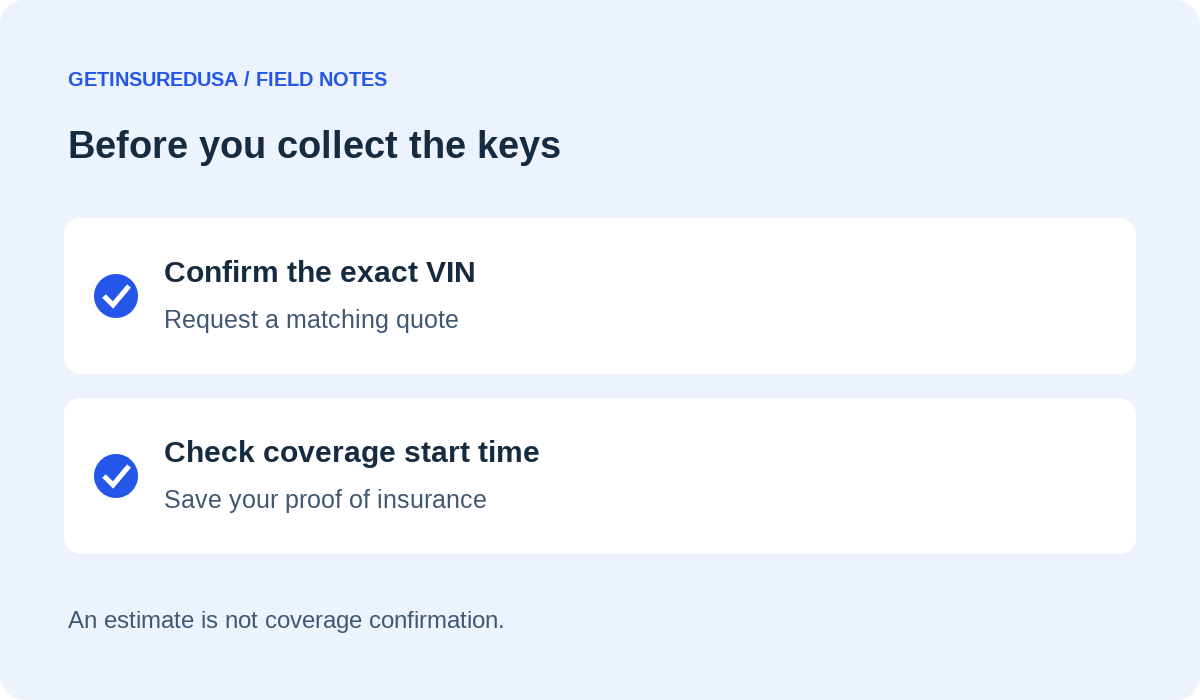
Ask the seller for the vehicle identification number and verify it against the car and paperwork before using it in a quote. A model name alone can conceal meaningful differences in trim, equipment and vehicle configuration. Have the provider confirm it has identified the correct vehicle. A quote for a similar car is a starting point, not a substitute for pricing the one you intend to buy.
Keep a private shopping note with the year, make, model, VIN, asking price and whether you expect to finance the purchase. Add the seller's known disclosures and any title information that may affect insurability. You do not need to broadcast this record to every website. Share requested information through an identified insurer or authorized intermediary's appropriate channel once you understand the purpose.
If you are comparing three cars, label each quote with the VIN and date. Otherwise, a lower insurance price can accidentally become attached to the wrong listing in your messages. Screenshots help, but a clear file name and a short written record are easier to review later. Ask for a revised written quote when the selected vehicle changes.
Price two cars with one consistent baseline
Use the same household drivers, address, vehicle use, liability limits and deductible selections when comparing vehicles. Changing those details at the same time makes it difficult to understand why the quotes differ. A lower price may reflect reduced coverage rather than a less expensive vehicle to insure. Mark any difference the provider cannot keep consistent and ask what it changes.
Think about your real driving arrangement. Where will the car normally be kept? Who will drive it? Will you commute, use it occasionally, deliver goods or provide rides through an app? Accurate use information matters more than finding a description that produces the lowest initial estimate. Ask the insurer how household drivers should be listed rather than guessing about exclusions or occasional use.
A simple comparison can sit beside the vehicle listing: purchase cost, expected loan payment, insurance quote for its stated term, maintenance findings and registration expenses. These are different categories with different timing. Do not multiply one attractive monthly figure into a complete ownership budget without checking the underlying assumptions. Our quote worksheet helps keep insurance details consistent.
State minimum coverage and protection for the car
Required liability protection and coverage for damage to your own car answer different questions. A policy meeting a state's financial-responsibility requirements may still leave you funding theft or collision damage yourself. Review the available coverages with a licensed provider and decide which losses you can absorb. Avoid treating the word “minimum” as a statement that a policy meets every household or financing need.
For your own vehicle, ask about collision and comprehensive separately. Compare each premium and deductible, and have the provider explain the settlement basis. A loan balance and the vehicle's value are not necessarily the same amount. Buying coverage for physical damage does not automatically guarantee that a total-loss settlement will clear all debt associated with the purchase.
Also ask about injury-related benefits, uninsured or underinsured motorist options and applicable state selections. The right combination depends on the jurisdiction and policy. You do not need to solve those questions from a seller's text message. Bring them to the insurer while there is still time to revise a quote and understand the documents before pickup.
Financing changes the conversation
Ask the lender for its written insurance requirements, including any deductible limits and how its interest should be listed. Then give that information to the insurer. Do not assume the dealership's financing approval means the insurance portion has been completed. Confirm which organization provides each document and who is responsible for sending proof to the lender.
Compare optional products separately. A service contract, maintenance plan, gap product and auto insurance policy have different purposes and terms. Ask what each costs, whether it is optional, who provides it and what cancellation rules apply. If a payment illustration combines several products, request an itemized version. A bundled monthly amount can make it hard to assess an individual choice.
For the insurance quote itself, include the full policy-period premium and payment schedule in your budget. The amount due at inception may differ from subsequent installments. Ask whether fees apply, whether autopay affects the price and what happens when the first term ends. An affordable purchase requires room for these details as well as the vehicle payment.
Private seller and dealership purchases
A dealership may coordinate paperwork, but you still need to understand the insurance effective date and the exact vehicle being covered. Ask what proof it requires before releasing the car. If the transaction is delayed, tell the insurer and have it explain whether the planned start date should change. Keep copies of the final documents rather than relying on a sales conversation.
A private sale may require more coordination between you, the seller, your insurer and the relevant motor-vehicle agency. Arrange the sequence in advance: inspection, payment, title paperwork, coverage confirmation and lawful transport or driving. The details vary by state. Do not improvise a drive home on the assumption that a seller's registration or policy automatically transfers with the keys.
Insurance is only one part of checking the transaction. The Texas attorney general recommends careful review of used-car information, including safety recalls and the buyer's guide where applicable. State resources can help you prepare questions about title and purchase documents. An insurance quote does not prove the seller owns the car or that the car is mechanically sound.
Do not confuse an estimate with a bound policy
An online estimate can change when a provider verifies details or receives additional information. Ask what remains unresolved: driver history, vehicle information, inspection, payment or underwriting review. Save the quote reference and expiration date if provided. A polished results screen can still be an illustration awaiting action, particularly if you have not selected an insurer and completed its process.
Before pickup, ask for confirmation of the effective date and time, the covered vehicle and the protection selected. Obtain the proof documents the provider issues and know how to retrieve them without a mobile signal. If a representative says something is covered under an existing policy, ask where that arrangement appears in the contract or written confirmation.
Our guide to comparing car insurance quotes explains how to keep offers aligned. It does not replace the final coverage confirmation. Treat quoting, applying, acceptance and proof as stages that may need separate attention. If you are unsure which stage you have reached, ask directly before driving or canceling another policy.
Existing damage, salvage and rebuilt titles
Disclose known damage and the vehicle's title status accurately. Ask whether the insurer accepts the vehicle for the coverages you want, whether an inspection is required and how existing damage would affect a later loss. A low purchase price can be offset by limited coverage options or uncertainty about valuation. Resolve those questions before treating the bargain as a completed decision.
Keep the independent inspection and purchase records. Photograph the vehicle's condition with the seller's permission where appropriate, and save repair documentation the seller provides. The purpose is an accurate record, not an attempt to make earlier damage look like a future insured event. A new policy generally does not convert a known pre-existing problem into a newly occurring loss.
If the car has prior hail damage, use our hail-damage insurance guide to prepare questions about condition and settlement. Do not assume that keeping comprehensive will pay to repair old dents after purchase. Ask the provider to distinguish the coverage available for future events from the damage and value already present.
California estimates: useful for planning, not a personal rate
California shoppers may see search results for a car insurance calculator or estimator. Check what those tools actually use: a sample profile, a broad average or information you supplied for a personal quote. A sample comparison can help identify questions, but it cannot establish your final premium. Use the exact car and consistent driver details when requesting written offers.
The California Department of Insurance provides a premium comparison resource based on sample scenarios. Its role is different from an insurer accepting your application. Read the assumptions behind any displayed number and compare the actual available protection. Our California guide links to official resources and covers questions to raise about a vehicle, mileage and financing before purchase.
If you are moving to California as part of the purchase, explain both the timing and where the car will be principally kept. Registration, proof and policy changes may require more than updating a mailing address. Ask the insurer and DMV about the correct sequence for your situation. Avoid using an old address merely because a preliminary quote looks lower.
Texas estimates: include the coverage selections
A Texas car insurance calculator result is useful only if you know what it estimates. Ask whether liability limits, comprehensive, collision, injury benefits and uninsured-driver options are included. Write down the policy period as well as the price. Two figures described as “monthly insurance” may represent different protection, fees and initial payment requirements.
Use the Texas Department of Insurance and Office of Public Insurance Counsel shopping resources to prepare questions. Our Texas insurance guide connects that preparation with a comparison worksheet. Ask the insurer to explain relevant coverage selections or rejection documents rather than clicking through them without understanding the effect. A used vehicle still deserves a deliberate coverage review.
For any Texas purchase, confirm current registration and insurance requirements with the appropriate official source. This article does not provide a universal grace period for adding cars. If your existing insurer describes temporary protection, ask whether it applies to this purchase and which coverage it provides. Record the answer before assuming that the date on the sales receipt settles the issue.
Electric and hybrid cars need model-specific questions
A used EV can look appealing when its purchase price is lower than expected, but price the insurance before committing. Ask about repair facilities, battery-related accidental damage, towing instructions and rental arrangements. These are practical ownership questions, not reasons to assume all electric cars cost more to insure than every gasoline vehicle. Compare exact models and consistent coverage.
Separate the battery warranty from auto insurance. The warranty's treatment of degradation or defects is a different matter from an insurance claim after a covered accident. Get each provider to explain its own product. A sales listing saying “battery covered” leaves too much unanswered if it does not identify who provides the protection, for what events and for how long.
Our EV insurance cost guide provides a longer question list. If the car has advanced driver-assistance equipment, ask the repairer about calibration after relevant damage. Do not assume an inexpensive cosmetic repair estimate includes every required step. A pre-purchase inspection and an insurance comparison work best when they address the same exact vehicle.
Choosing a deductible with a purchase budget
It is easy to use a larger deductible to make an insurance quote fit after spending most of your savings on a car. Pause and calculate the cash you would have available after the purchase, taxes, fees and immediate maintenance. A deductible you cannot fund may create a serious problem when the car is damaged and you need it for work.
Ask for two otherwise identical quote versions. Compare the premium savings with the additional amount you would accept after a covered loss. Keep comprehensive and collision separate in the calculation. The deductible guide includes worked examples; the useful numbers for your decision are the provider's actual offers and your available reserve, not a universal recommended amount.
For a low-value car, ask how value affects potential settlement and compare that with the cost of retaining physical-damage coverage. For a financed car, check the lender's requirements first. There is no single birthday at which a used car becomes “too old” for comprehensive or collision. The relevant questions concern value, terms, costs and your ability to absorb a loss.
A realistic purchase-day timeline
The day before pickup, confirm the vehicle, quote details and expected transaction timing. Ask how to complete any remaining insurance steps and how the proof will arrive. Check whether the provider can handle a schedule change outside normal hours. Save its official contact information rather than relying on a link forwarded by a seller or an unknown intermediary.
On purchase day, compare the VIN on the final documents with the one quoted. Resolve any mismatch before proceeding. Confirm coverage and proof using the insurer's process, then retain the transaction documents in your own records. A busy desk or a waiting seller is not a reason to skip a correction that affects which vehicle the policy describes.
After pickup, review the issued declarations as soon as they arrive. Check drivers, vehicle, address, selected limits, deductibles and lender information. Ask about discrepancies promptly and keep the response. If another car is being sold or replaced, discuss its removal separately so an accidental overlap or gap does not become an unexpected expense or coverage question.
A fictional two-car comparison
Imagine you are choosing between a seven-year-old sedan and a newer crossover. The sedan costs less to buy, while the crossover has equipment you prefer. Rather than assuming the sedan wins on insurance, request quotes with the same drivers and selected coverages. Keep the car inspections separate and record each policy's complete term price alongside the purchase price.
Suppose, purely as an illustration, the crossover's insurance quote is $180 more for a six-month term. That does not make its annual cost definitively $360 more forever; renewal prices can change. It does show an initial budgeting difference under the quoted terms. Ask what vehicle or coverage details explain it and whether any options changed between the two versions.
Now factor in the inspection findings and the money remaining after purchase. One car may need immediate tires; the other may leave you with too little deductible reserve. You are comparing an ownership plan, not only insurance. The goal is to notice these trade-offs before paying, when you can still choose another vehicle or revise the financing proposal.
This example is deliberately not a recommendation for either body style. An exact VIN, household and insurer can produce a different result. Its value is the sequence: inspect, quote consistently, itemize the total, confirm coverage and preserve the records. That approach is more reliable than collecting unrelated estimates until one appears to justify the vehicle you already want.
When pickup is delayed or the sale falls through
Tell the insurer if the planned purchase date changes. Ask whether the arranged effective date still makes sense, whether an amendment is required and how any paid premium would be treated if you do not buy the car. Avoid assuming a dealer's delay automatically updates the insurance file. The seller and insurer have different records, and you may need to coordinate the change yourself.
If you choose a different car at the last minute, start with the new VIN. Confirm the revised price, coverage and proof rather than asking someone to reuse the old card. Even when the seller says the cars are equivalent, the insurance documents should describe the vehicle you actually buy. Check any changed lender information as well, particularly if a different financing proposal accompanies the switch.
Keep a record of canceled or superseded quotes so you do not accidentally pay for an old selection from your phone. Label the final accepted policy clearly and save the official contact channel. A busy purchase day can generate numerous texts, screenshots and links. A simple record showing the chosen VIN, insurer, policy number and effective date is easier to use when you need proof later.
A final check on the first statement
When the first statement arrives, compare it with the accepted quote and payment schedule. Ask about an unexplained difference rather than assuming it will correct itself at renewal. Check that any discount or payment arrangement discussed actually appears where expected. If verification changed the price, ask which information changed and request a written explanation you can keep with the original quote.
Review the deductible amounts again. A selection made in a hurry on a mobile screen can be different from the version you first compared. Also confirm all intended household drivers, the garaging address and lender information. Correcting a factual error is different from choosing less coverage to make the statement match a target price; know which action you are asking the provider to make.
Finally, set a reminder in your own calendar to review renewal documents when they arrive. Keep the purchase inspection and insurance file together, but remember they serve separate purposes. The best time to organize them is while the transaction is fresh. That leaves you with a reliable record if you later sell the car, change insurers, question a payment or report damage.
Questions to finish before you drive home
Can I use the seller's insurance temporarily?
Do not assume the seller's policy protects you after ownership changes. Ask your insurer about your own arrangement and confirm the effective date. A policy document showing the seller's name is not proof that you have bought coverage. If transport is needed before you can arrange protection, discuss lawful options instead of guessing about a temporary exception.
Does a dealership quote include every required coverage?
Ask who issued the quote and what it includes. Verify state requirements, lender requirements and your selected optional protection separately. A price included in a vehicle payment conversation may be an estimate or a different product. Request an itemized insurance summary and confirm acceptance directly through the provider's official process.
Will an older car always be cheaper to insure?
No universal rule settles that question. Vehicle value is one consideration, but the exact model, coverage, driver details and insurer matter. Quote the actual alternatives on a consistent basis. A paid-off vehicle may give you more flexibility in selecting physical-damage protection, but removing coverage also changes the loss you must fund yourself.
Do I need a new quote if I change the car?
Have the provider confirm the new VIN and revise the quote. Even a similar trim or model year can change the information used in pricing. Do not rely on a screenshot prepared for another vehicle. Before purchase, make sure the effective coverage identifies the car you are actually collecting and the selections you intended.
Sources and next steps
Research checked November 26, 2026: Texas attorney general's car-buying guidance, Texas insurance FAQ, OPIC shopping guide, California premium comparisons, and NAIC consumer information. Verify current state and policy requirements for your own purchase.
Start with one action: obtain the VIN for the car you are seriously considering and request a written insurance quote before committing. Keep your comparison focused on the same protection, then confirm the final coverage before driving. Our coverage guides and state resources can help you prepare the questions that remain unanswered.